
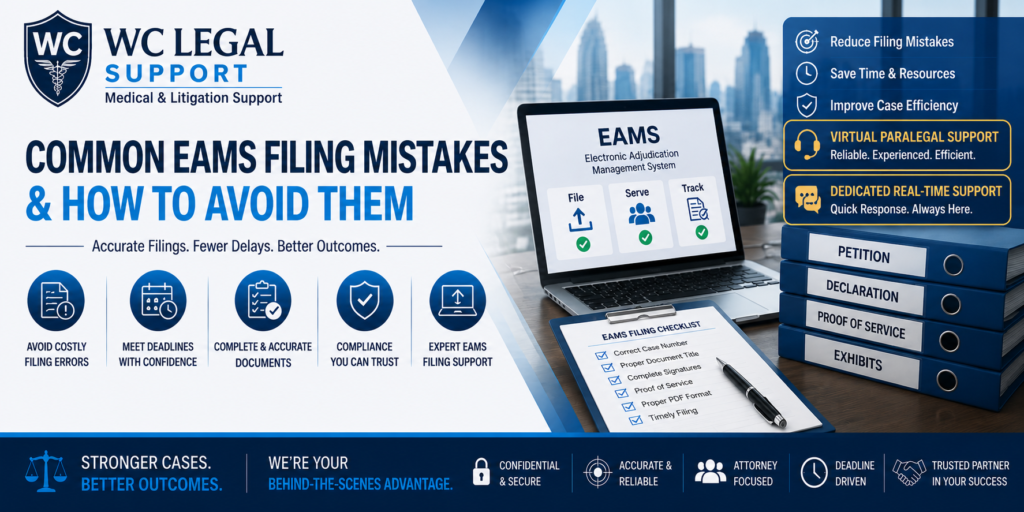
Accurate document filing is a critical part of every California Workers’ Compensation case. Even when legal arguments are strong, administrative errors during the filing process can lead to unnecessary delays, rejected submissions, and additional work for attorneys and legal staff. The Electronic Adjudication Management System (EAMS) has streamlined the filing process by allowing electronic submission of documents to the Workers’ Compensation Appeals Board (WCAB). However, it also requires strict compliance with filing procedures and document formatting standards.
Most EAMS filing errors are not caused by a lack of legal knowledge. Instead, they result from simple oversights such as incorrect case information, improperly prepared documents, or rushed submissions. Establishing a consistent filing process can significantly reduce these mistakes and improve overall office efficiency.
Why Filing Accuracy Matters
Every document submitted through EAMS becomes part of the official case record. An error in the filing process can affect case timelines, hearings, settlements, or other legal proceedings.
Common consequences of filing mistakes include:
- Rejected or delayed filings
- Missed deadlines
- Additional administrative work
- Increased costs
- Frustration for attorneys and clients
- Time spent correcting avoidable errors
Reviewing documents carefully before submission helps prevent many of these issues.
Common EAMS Filing Mistakes
1. Incorrect Case Number
Entering the wrong ADJ number is one of the most common filing mistakes. Even a single incorrect digit can cause documents to be associated with the wrong case or result in a rejected filing.
How to avoid it:
- Verify the ADJ number before submission.
- Compare it with the latest case documents.
- Double-check every digit during the final review.
2. Selecting the Wrong Document Title
Choosing an incorrect document title can delay processing because EAMS categorizes filings based on the selected document type.
Best practices:
- Review the document carefully before filing.
- Match it with the appropriate EAMS document title.
- Maintain an internal reference list for commonly used filing categories.
3. Uploading Improperly Formatted PDFs
Technical issues with PDF documents frequently lead to filing problems. Common issues include poor scan quality, missing pages, password protection, blank pages, and incorrect page orientation.
Before uploading:
- Open the PDF and review every page.
- Confirm readability.
- Remove unnecessary blank pages.
- Ensure signatures are visible.
- Verify the document is complete.
4. Combining Documents Incorrectly
Submitting multiple unrelated documents as one PDF can create confusion during processing.
Instead:
- Follow EAMS filing guidelines.
- Organize documents properly.
- Separate documents when required.
- Maintain a standardized filing procedure.
5. Missing Required Signatures
Unsigned documents are another frequent cause of filing delays. Draft versions are sometimes mistakenly submitted instead of finalized copies.
Prevent this by:
- Reviewing every signature page.
- Confirming the final signed version is being uploaded.
- Using a checklist before submission.
6. Filing at the Last Minute
Waiting until the deadline leaves little room to correct unexpected issues such as missing signatures, technical problems, or document revisions.
A better approach is to:
- Prepare filings in advance.
- Obtain signatures early.
- Complete a quality review before the filing deadline.
- Allow sufficient time to resolve unexpected problems.
7. Errors in the Proof of Service
An incomplete or inaccurate Proof of Service can create additional administrative work and procedural complications.
Common mistakes include:
- Incorrect service dates
- Missing recipients
- Outdated addresses
- Missing signatures
Always verify recipient information and review the completed Proof of Service before filing.
8. Uploading the Wrong Document Version
Law firms often maintain multiple versions of the same document during drafting. Accidentally filing an outdated or unsigned version can create unnecessary delays.
Helpful practices include:
- Using consistent file naming conventions.
- Separating draft documents from final versions.
- Confirming that the attorney-approved copy is selected before submission.
9. Skipping the Final Review
A final quality check is one of the simplest ways to prevent filing errors.
Review the following before submitting:
- Correct ADJ number
- Correct document title
- Readable PDF
- Proper page order
- Required signatures
- Proof of Service
- Correct document version
- Complete attachments
A standardized checklist helps ensure consistency across every filing.
10. Assuming Every Filing Is the Same
Although many Workers’ Compensation filings appear similar, each case may involve different procedural requirements. Treating every filing as routine increases the likelihood of mistakes.
Before filing:
- Review attorney instructions.
- Verify procedural requirements.
- Confirm supporting documents.
- Ensure case-specific information is accurate.
Best Practices for Successful EAMS Filings
Law firms can improve filing accuracy by adopting a standardized workflow. A reliable filing process should include:
- Verifying the ADJ number.
- Selecting the correct document title.
- Reviewing PDF quality.
- Confirming required signatures.
- Checking page order.
- Reviewing the Proof of Service.
- Performing a final quality review.
- Filing before applicable deadlines.
Consistency is often the most effective way to reduce administrative errors.
Benefits of Professional EAMS Filing Support
As Workers’ Compensation practices become busier, attorneys spend considerable time managing administrative tasks in addition to legal work. Professional litigation support can assist with document preparation, PDF organization, filing reviews, and EAMS submissions, allowing attorneys to focus on representing their clients.
Experienced support professionals can help:
- Improve filing accuracy.
- Reduce administrative workload.
- Organize documents efficiently.
- Prepare filing-ready PDFs.
- Meet filing deadlines consistently.
- Increase office productivity.
A structured support process also promotes consistency and reduces the risk of avoidable filing errors.
Conclusion
Accurate EAMS filing plays an important role in efficient case management. While many filing mistakes are relatively minor, they can lead to delays, rejected submissions, and unnecessary administrative work. Most of these issues are preventable through careful review, standardized procedures, and attention to detail.
By verifying case information, preparing documents correctly, using filing checklists, and allowing adequate time before deadlines, law firms can significantly improve the quality of their EAMS submissions. A disciplined filing process not only reduces errors but also helps attorneys spend more time on legal strategy and client advocacy, ultimately contributing to smoother case management and better service for clients.